Not 'is the model up', but 'why did the agent do that'. Agent observability is seeing an autonomous agent's every model call, tool call and reasoning step as one trace.
When an AI agent is only answering, you can read the reply and judge it. When it is acting, calling tools, changing state, looping until a goal is met, the reply tells you nothing about how it got there. Agent observability is the practice of capturing every model call, tool call and reasoning step an agent takes as structured telemetry, so that when it does something surprising you can answer the one question that matters: why did it do that?
Ordinary monitoring tells you the service is up and the model returned a 200. That is silent on the thing you actually need to know: the agent read the wrong field, called the refund tool instead of the lookup tool, and looped three times before it stopped. Agent observability is what makes that chain visible.
Why it matters
The shift from advising to acting changes what you have to be able to see.
An agent is defined by what it can touch, so the surface is its tools. The interesting failures are not the model being slow; they are the agent calling the wrong tool, with the wrong argument, confidently. You cannot see that without tracing the tool calls.
Non-determinism means you cannot just re-run it. The same input can take a different path next time, so the record of what actually happened is the only ground truth you have. A trace of the run is that record.
The question changes from "what broke" to "why did it choose that". A stack trace tells you where the code failed. An agent needs a decision trace: what it read, what it decided, what it did, in order.
The standard, so this is not vendor lock-in
There is now an agreed way to do it. OpenTelemetry's GenAI semantic conventions define the span shapes for an agent run: a root invoke_agent span for the whole invocation, a child span for each model call (the reasoning), and a child span for each tool call (the action), plus latency and token metrics. Read the span tree and you have the agent's decision trace: what it thought and what it did, in order. Frameworks such as LangChain, CrewAI and AutoGen already emit these spans, and the major platforms read them, so you are instrumenting to a standard, not to one product.
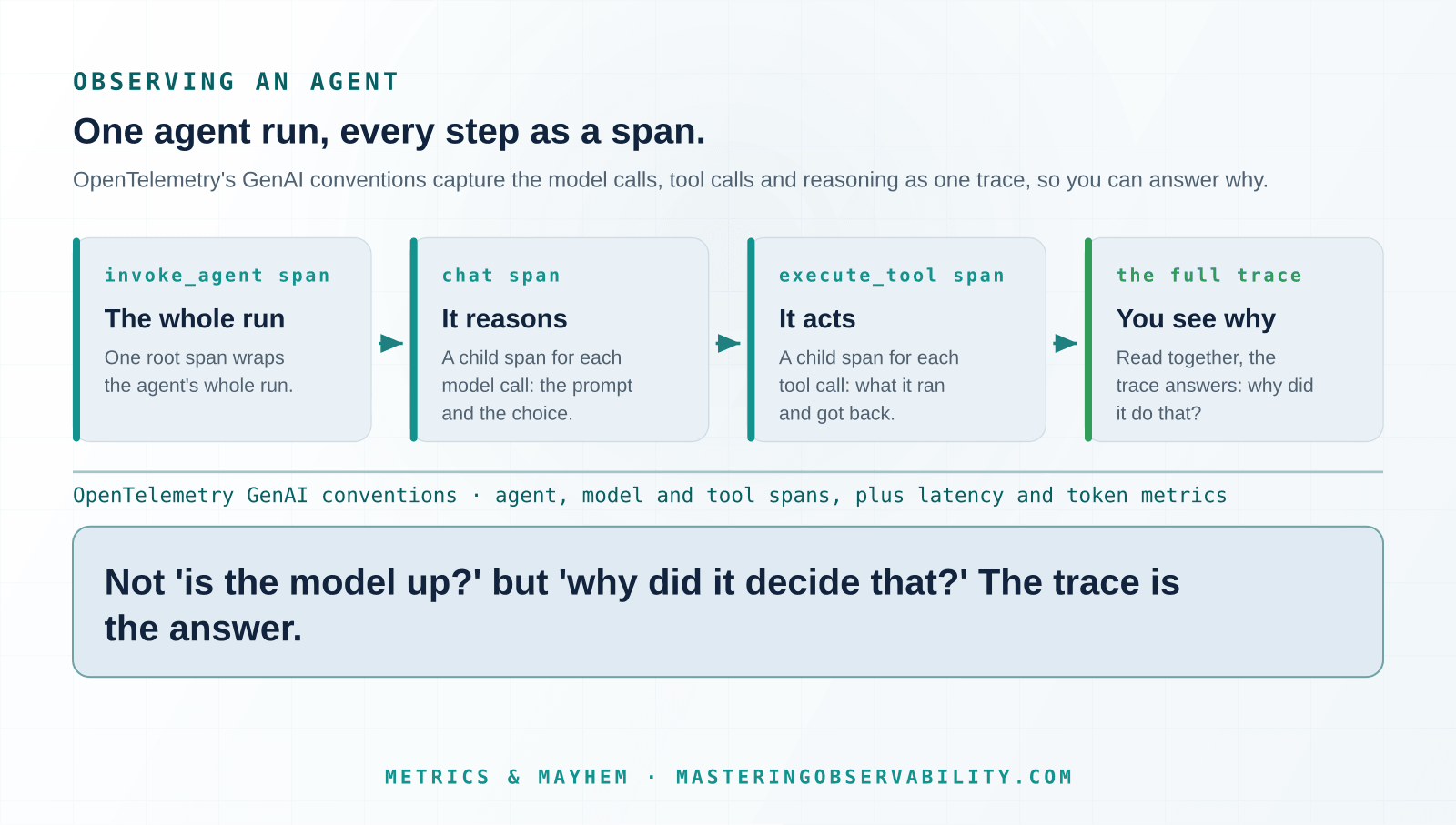
One agent run, every step as a span: invoke_agent wraps the run, a chat span per model call, an execute_tool span per tool call. Read together, the trace answers why the agent did that.
The catch
More spans, more cost. Every model and tool call is telemetry, and capturing all of it carries a token and storage bill. You still choose what is worth recording, the same discipline as any observability.
A trace shows what happened, not whether it was right. It tells you the agent called the refund tool; judging whether it should have is still a human's job, or an eval's. Observability and evaluation are two different things, and you need both.
Instrument the intent, not just the call. A span that says "tool executed" is far weaker than one that carries why the agent chose it. The value is in the context, and adding that context is your work, not the framework's.
So, is agent observability for you?
If your agent only drafts and suggests, ordinary logging may be enough. The moment it is allowed to act, to call tools, change production state, or loop on its own, you cannot operate it safely without seeing why it did what it did. That is the line agent observability is built for. And the moment it acts, someone owns the outcome, which is the whole question in When The Agent Acts, Who Owns The Decision?
Agent observability is not another dashboard. It is the trace that answers 'why did the agent do that', the one question that ordinary monitoring cannot answer.
Get the next one One signal a week. No noise. | |
If this was useful, Metrics & Mayhem sends one short, practical piece like it to IT operations leaders most weeks. No fluff, no vendor noise.
Prefer to start with the book? Read a free chapter. |