

Ask a vendor why observability rollouts stall and you get a technical answer. Instrumentation coverage. Agent deployment. Sampling strategy. Collector configuration. Cardinality. All real problems, all solvable, all documented into the ground by people who know what they are doing.
Then go and sit in the actual programme meeting.
What you find is a room of capable engineers who have already solved the technical problem and still cannot move. Not because the traces are wrong. Because nobody in the room agrees on what they are supposed to be tracing, who owns it when it breaks, or whether the data describing the estate is good enough to trust in the first place. The tooling is fine. The tooling has been fine for years.
The blocker is almost never the telemetry. It is the agreement.
That is an uncomfortable thing to write, because agreement is not something you can procure, and it does not have a quickstart guide.
The blocker is almost never the telemetry. It is the agreement. |
The Question That Stalls Every Rollout
Somebody eventually asks what looks like the easy one: what is a business journey?
Watch the room when that lands. Everyone knows the answer, and no two people give the same one. The application team describes a sequence of technical calls. The service owner describes something closer to a customer outcome. Risk describes a control boundary. Somebody from the platform side describes a set of components, which is not a journey at all, it is an inventory with ambition.
They are all being reasonable. That is the problem. A business journey is not the same thing as a set of technical process steps that happen to run in order, and if you cannot separate those two ideas, you cannot draw the boundary of the thing you are meant to be observing. You end up instrumenting components, then reporting on components, then wondering why the executive dashboard says green while a customer cannot complete a payment.
Here is the rule, and I would give it to anyone: define one journey, end to end, in business language, before you instrument anything.
Here is where the rule breaks. In a genuinely large estate, "end to end" crosses systems that predate everyone in the room, some of which nobody can change and one of which is probably a supplier's black box. Purity is not available. So the working version is narrower: define the journey end to end in language the business recognises, then be explicit about which segments you can see, which you can only infer, and which are dark. A journey with three honest gaps in it is a usable map. A journey with three quiet assumptions in it is a trap you will spring on yourself at two in the morning.
Nobody Wants to Go First
Assume you get the definition agreed. Now you need somebody to actually do it.
In a large organisation, a single journey is owned by nobody, which is another way of saying it is owned by nine teams. Each of those teams has a delivery plan that was set before your programme existed. Each of them will support the initiative in principle. And each of them is watching the other eight to see who commits first, because going first means absorbing the effort, the schema arguments and the awkward discovery that your own service is noisier than you claimed, all while the other eight watch.
Nobody moves.
This gets read as resistance. It is not resistance, it is rational behaviour under uncertainty, and treating it as a culture problem makes it worse. The people hedging are not being obstructive, they are protecting a delivery commitment somebody else already gave on their behalf.
What actually unsticks it, in my experience, is removing the risk of being first rather than appealing to the value of being first. That means someone senior enough to reallocate a sprint says out loud which team goes first, what they are allowed to drop in exchange, and what specifically counts as done. Not a steering group nodding at a roadmap. A named team, a named trade, a named finish line.
I could be wrong about the sequencing here, and I have seen bottom-up rollouts work where one team simply started and the results dragged everyone else along. But those were smaller estates, and they had a champion with unusual air cover. In a bank or a government department, waiting for that to happen organically is a plan in the same way that waiting for rain is irrigation.
Your Governance Is Producing a Worse Audit Trail
This one still annoys me.
A lot of regulated estates run a control that says incident records must be locked once written, so the audit trail cannot be tampered with. The intent is sound. The effect, over and over, is that the record which finally reaches the auditor is a tidy summary written after the fact by somebody reconstructing events from memory and a chat log.
Meanwhile the real audit trail, the one showing what people actually believed at 03:20, what they ruled out, which change they suspected and why they were wrong, never gets captured at all. It was live context. Live context does not survive a policy that forbids live updates.
That is not a governance control. That is a data-loss policy with a compliance badge on it.
The fix is not to weaken the control. It is to separate immutability from currency: append-only rather than write-once, with the reasoning captured as it happens and nothing overwritten. Every version kept, every author stamped, nothing lost. You get a stronger evidential record and a usable one, which is the outcome the original control was reaching for before it got implemented by people who were never in the room at 03:20.
Ask who wrote your incident-record control, and whether anyone who has held the rota was consulted. The answer explains a great deal.
That is not a governance control. That is a data-loss policy with a compliance badge on it. |
The Unglamorous Prerequisite Everyone Skips
Underneath all of this sits the least interesting problem in the estate, which is knowing what you have.
Configuration and asset data. The register of what exists, what it depends on, who owns it, what it supports. Nobody's career was ever made by fixing it. It is not a keynote. It is, however, the thing every downstream capability quietly assumes is correct: your service maps, your dependency graphs, your alert routing, your impact analysis, and every automation or model you eventually layer on top.
If that register is stale, the observability programme does not fail loudly. It fails politely. Dashboards populate. Correlation runs. The output is subtly wrong in ways that take months to notice, because the system is confidently describing an estate that no longer exists.
I have been the person who pushed the tooling forward anyway, knowing the asset data was thin, because the tooling was the part I could control and the asset data belonged to somebody who was not in my programme. It bought me visible progress for two quarters and a much harder conversation afterwards. That is the trade you are making when you skip it, whether or not you say so out loud.
You do not need a perfect register. You need a centrally owned one, with a named owner, a defined refresh, and an honest map of where it is unreliable.
"Can We Just Turn the AI On?"
And then, near the top, someone asks whether we can just turn the AI on.
It is a fair question asked at the wrong point in the sequence. The pressure is real, the budget cycle is real, and the promise on the slide is genuinely attractive. But it is the same problem as everything above, wearing a better suit: it wants the outcome without funding the foundation the outcome depends on.
An AI layer over an estate with contested journey definitions, split ownership, a sanitised incident history and an unreliable asset register does not fix any of those. It industrialises them. You get faster, more confident answers derived from the same weak inputs, and now they arrive with the authority of a machine, which makes them harder to challenge in a room full of people who want to believe them.
Garbage in, garbage out is an old line. It became a boring one because it kept being right.
What to Do Before You Instrument Anything
If you are about to start, or you are three months in and stuck, this is the order I would work in.
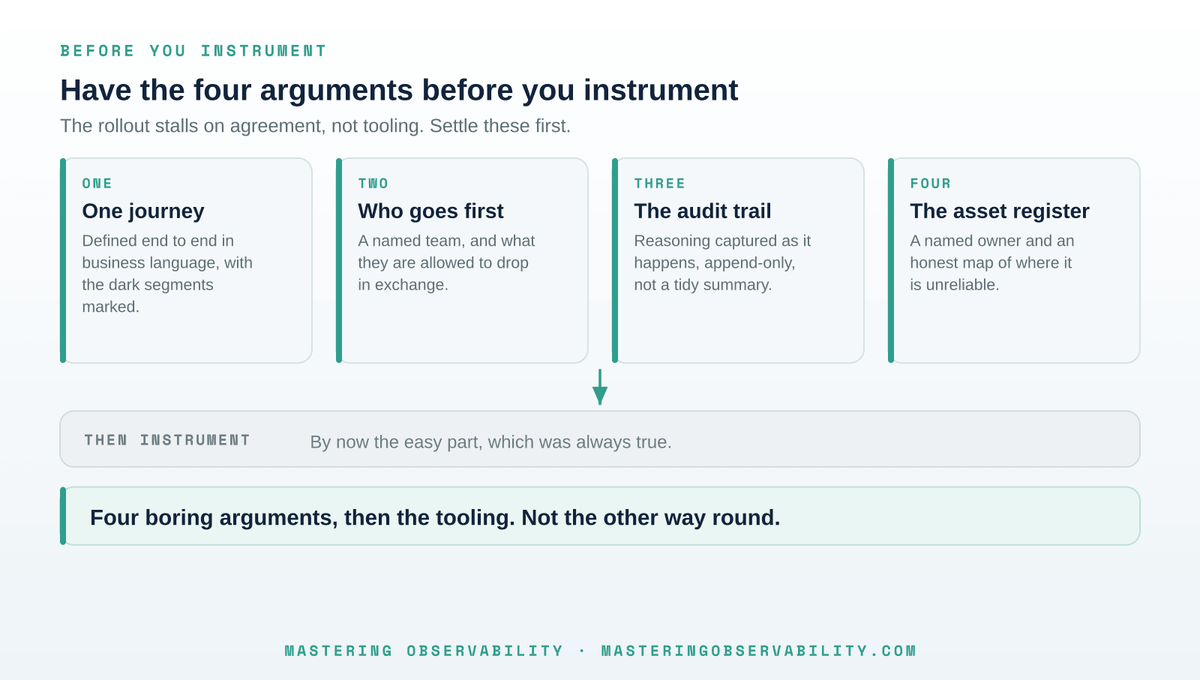
Four boring arguments, in order. The instrumentation is the easy part, which is why the vendors are so confident about it.
Define one journey in business language and write down its dark segments. One. Not a portfolio. The argument you have while doing this is the actual work.
Name the team that goes first, and name what they get to drop. If nobody can authorise the trade, you do not have a programme, you have an intention.
Audit your incident-record control for whether it captures reasoning or only conclusions. If it only captures conclusions, you are losing the evidence you will most want later.
Give the configuration and asset register a named owner and an honest reliability map. Not a project to fix it. An owner, and a public statement of where it lies.
Then instrument. By this point the instrumentation is the easy part, which was always true, and is why the vendors are so confident about it.
None of that is a technology decision, which is precisely why it keeps getting skipped in favour of one. The rollout that succeeds is rarely the one with the better collector configuration. It is the one where somebody was willing to have four boring arguments before anybody wrote a line of instrumentation.
Have the arguments first. They are cheaper in a meeting room than in a bridge call.
Get the next one One signal a week. No noise. | |
If this was useful, Metrics & Mayhem sends one short, practical piece like it to IT operations leaders most weeks. No fluff, no vendor noise.
Prefer to start with the book? Read a free chapter. |
The Observability Maturity Assessment: Where Does Your Team Actually Stand?. Five levels, used as a map of what to fix next.
Own the Signal, Rent the Platform. Owning the layer the whole rollout depends on.