
The AIOps and service-management platform for the enterprise that never got to greenfield, and the honest question to ask before you consolidate onto it.
Most observability writing is written for the greenfield. A clean Kubernetes estate, a fresh OpenTelemetry pipeline, nobody's legacy holding the actual money. That is not the world most large enterprises live in. They live with decades of layered systems, a service desk that predates half the team, and a mandate to see it all from one place. BMC Helix is built squarely for that world, so it is worth an honest, plain read on what it is and where it fits. I have not run it hands-on. This is a read from current public product positioning, triangulated with what its own users report on Gartner Peer Insights, PeerSpot and G2, and where the evidence runs out I have said so rather than filled the space with guesswork.
What is BMC Helix?
BMC Helix is a cloud-based platform for IT service management (ITSM), IT operations management (ITOM) and AIOps, with observability folded in. In plain terms, it is one suite covering three jobs that used to be three separate tool categories: running the service desk (tickets, changes, incidents), watching the infrastructure and applications, and using automation and AI to connect the two, so that a problem in the plumbing links to the business service it affects. The lineage runs back through BMC's older on-premises products, Remedy, TrueSight and Patrol, rebuilt onto a containerised cloud architecture.
One correction before anything else, because a good deal of what is written about Helix is now out of date. BMC Helix is no longer a product line inside BMC Software. BMC announced in October 2024 that it would separate into two independent companies, and the split went through in 2025: BMC kept the mainframe software and automation business, and the digital service and operations management business became BMC Helix. The websites followed in October 2025, so BMC Helix now sells from helixops.ai and the old bmc.com product URLs redirect there. If you are reading a comparison that files Helix as one arm of a mainframe company, it predates the split.
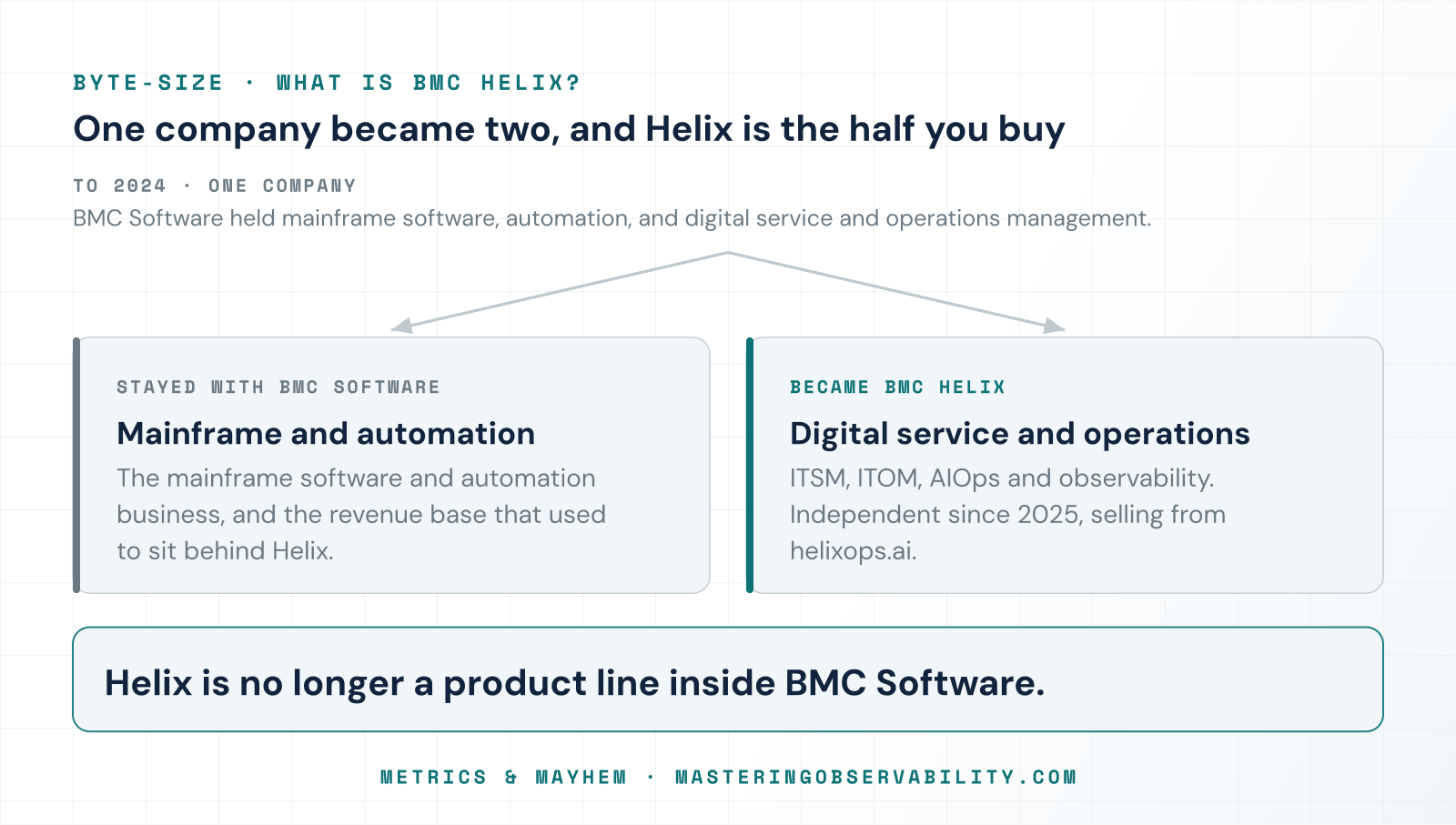
The 2025 separation, and which half of it BMC Helix actually is. Source: the current BMC Helix and BMC Software product pages, plus CIO's reporting on the split (October 2024 and December 2025).
The module names are worth getting right too, because enterprise suites reshuffle them often. On its current product pages BMC Helix splits its own catalogue into service management (BMC Helix ITSM, Digital Workplace, Business Workflows, Customer Service Management) and AIOps and observability (BMC Helix Discovery, BMC Helix Operations Management with AIOps, BMC Helix Network Management, BMC Helix Continuous Optimization). The umbrella pitch is agentic AI for what BMC Helix calls ServiceOps: running service management and operations as one discipline instead of two.
First, what is AIOps?
The whole Helix pitch leans on AIOps, so it is worth thirty seconds. AIOps means using machine learning over your operational data (events, metrics, logs, changes) to cut the noise, group related alerts into a single probable cause, and point operators at what actually matters. The promise is fewer things lighting up at once and a faster answer to "what changed." The reality is that AIOps is only ever as good as the data and the service model you feed it. It is a technique with prerequisites, and those prerequisites bite harder the bigger and messier the estate.
What it does well (on positioning and user reviews)
Taken on its current public positioning, and cross-checked against aggregated user reviews, five things stand out as genuine strengths for the audience it targets:
It joins service management to operations. BMC's real heritage is the service desk, and Helix's central idea is that watching a system and running the service desk for that system should not be two disconnected worlds. For an enterprise where the ticket queue and the monitoring wall have never spoken to each other, that join is the point.
It is built for hybrid and messy, not just cloud-native. BMC Helix positions itself for large hybrid estates: on-prem, cloud, mainframe and the older systems in between. That is the harder half of most enterprises and the half greenfield-first tools quietly skip.
A live service and dependency model, discovered without agents everywhere. BMC Helix says its discovery is lightweight and agentless and keeps service models updated in near real time. Reviewers on PeerSpot back the substance of that one: the dependency mapping and the low deployment tax are among the most consistently praised parts, particularly on large mixed estates. A platform that already knows what your services are, and what depends on what, has a head start on turning an alert into "here is the business service this affects and who owns it."
The AIOps and analytics get real credit from users. Across aggregated public reviews on Gartner Peer Insights and PeerSpot, event correlation, noise reduction and predictive analytics are what users single out, and several describe BMC as early rather than late to putting machine learning into operations. BMC Helix also points to a Forrester AIOps Platforms Wave placing. That is BMC Helix's claim about a report you should go and read yourself, not a result I can vouch for.
Broad ingestion and integration. BMC Helix says it takes in metrics, events, logs, traces, incidents, changes and topology from its own and third-party sources. Users credit that breadth, and it is the reason the single-pane claim survives contact with a real estate here more often than it does with some suites.
A fair caveat on all five: the design intentions are BMC Helix's own claims, and the review sentiment is aggregated user reporting, not a verdict from my own testing. Treat them as the shape of the offer, then test the shape against your estate.
The honest ledger
Every suite this broad charges for its breadth somewhere, and the charge is rarely on the licence line alone. These are the places a careful buyer should push.
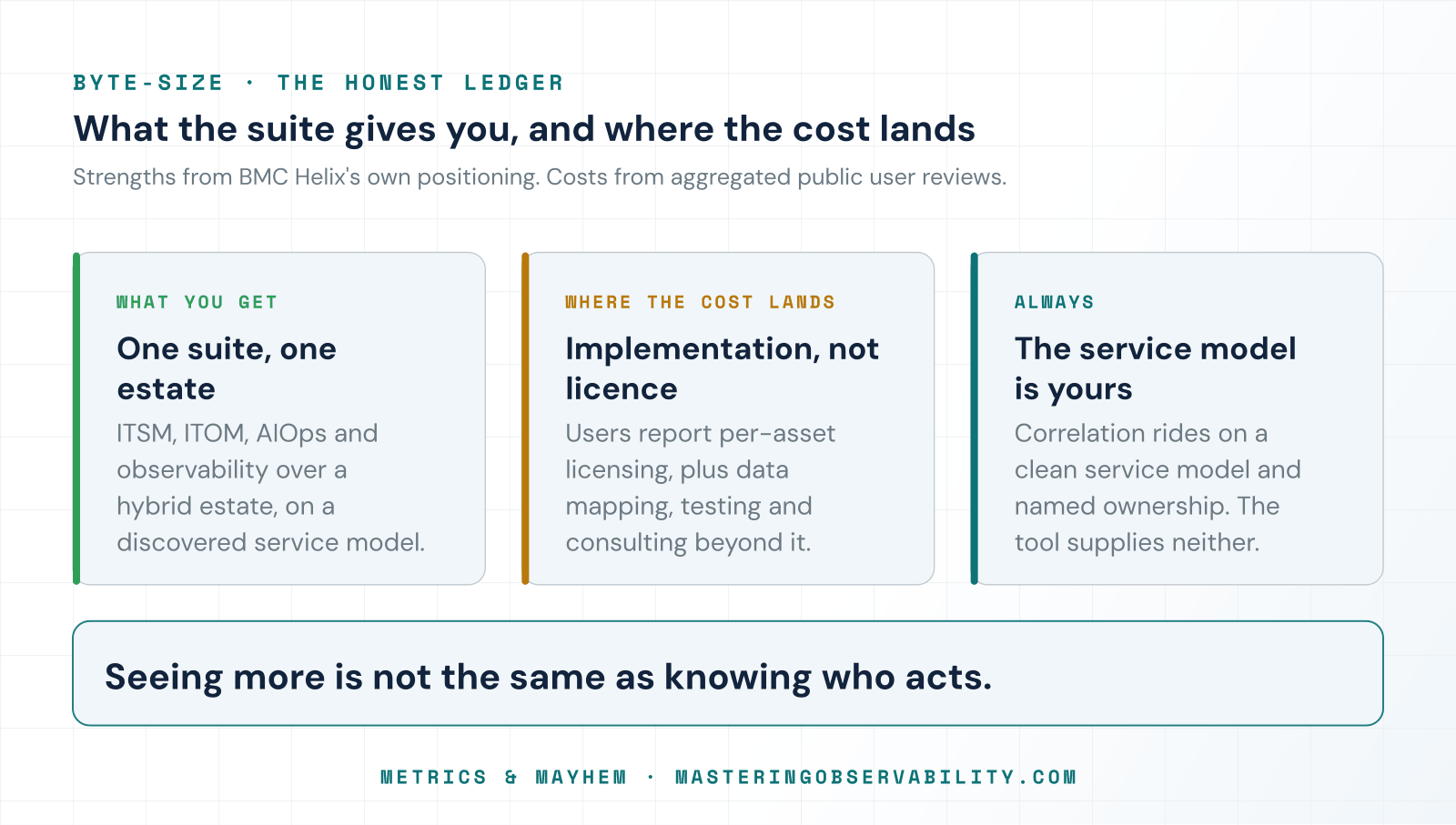
The breadth on one side, the effort it asks of you on the other. Source: BMC Helix's own product positioning for what you get, and aggregated public user reviews on Gartner Peer Insights and PeerSpot for where the cost lands.
Breadth is a promise and a burden. A platform that covers ITSM, ITOM, AIOps and observability is doing a lot. The upside is one pane over a sprawl. The risk is that a broad suite is rarely best-in-class at every layer, and consolidation projects live or die on the integration and migration work, not the demo. Ask which layers are genuinely strong and which are there to complete the picture.
What its own users most often flag. In aggregated public reviews the recurring complaints cluster in four places: a licensing model users describe as complex and expensive, especially where it is counted per asset; an implementation and upgrade effort that needs real planning, data mapping and testing, with consulting cost running well beyond the licence; performance and stability that reviewers say has room to improve; and documentation they find thin in places. Reviewers are also blunt that the payoff depends on your ITSM maturity. If your service model and ownership are not already in decent shape, the platform will not manufacture them for you.
AIOps quality rides on your data and your model. Correlation and noise reduction only work if the underlying service model and event data are clean. On a mature, layered enterprise estate that is real work, not a switch you flip. The tool does not create operational trust. It supports it once you have done the ownership work underneath.
A newly independent vendor, and a quiet practitioner footprint. This is the diligence item most write-ups miss. BMC Helix has stood on its own only since 2025, so its roadmap, its support model and its partner network are being rebuilt at the same time as it sells to you. Gartner's Gregg Siegfried, quoted when the split was announced, put the sharper version of it: these products no longer have mainframe revenue behind them. Alongside that, Helix barely registers in the open observability conversation and surfaces mainly as a ServiceNow or ITSM alternative. None of that is a verdict on the product. It does tell you this is an enterprise-incumbent choice rather than one with a groundswell of practitioner advocates, so lean on references, contract novation and a real proof of value, not on community buzz.
Suite gravity cuts both ways. The reason to buy a single suite (everything in one place) is also the lock-in risk (everything in one vendor). That is a fair trade for some organisations and the wrong one for others. It is a deliberate decision to make with eyes open, not a detail to discover later.
A tool does not fix an accountability gap. This is the pattern I keep coming back to across every vendor. If nobody owns the service, no platform, however capable, will tell you who should. Seeing more is not the same as knowing who acts. The plumbing is the easy part. The operating model is the hard part, and it is on you.
Is BMC Helix the right tool for you?
If you are a large enterprise with a real hybrid estate, an established service-desk practice, and a mandate to consolidate overlapping tools onto one platform that joins operations to service management, BMC Helix is a serious candidate and belongs on your shortlist. If you are a lean, cloud-native shop chasing best-in-class at each layer with minimal lock-in, a broad enterprise suite is likely more platform than you need, and a focused, open stack may fit better.
Either way, the question I would want answered before I put my name next to a consolidation is not "how good is the demo." It is "how honest is the migration plan, and what does this cost me in engineering time, not just licence." With a vendor this newly separated, add a second one: show me the roadmap and the support model you own now, not the one you inherited. Strong suites are exactly where those questions earn their keep.
Have you run a consolidation onto BMC Helix, or looked hard at it and walked? I would like to hear it, the good and the awkward. Reply, or book a slot and tell me what you found.
Disclosure: I have spoken with the BMC Helix team and may collaborate with them on future content. I have not been given a demo or a trial, and nothing from any private conversation is used here. The opinion is my own, drawn from public product positioning and aggregated public user reviews, and it stays honest, including the parts a vendor would rather I left out.
byte-size: What Is Odigos? The same disclosed, honest read, on the open-source end of the market.
byte-size: What Is Agent Observability? What changes when the thing you are watching acts on its own.
The Open-Source Observability Stack: A Field Guide The counterweight to a single suite, with the honest catch on every piece.
Own the Signal, Rent the Platform Why the instrumentation layer, not the platform, is the part worth protecting in a consolidation.
Sources / further reading
BMC Helix product overview (official positioning): https://www.helixops.ai/it-solutions/bmc-helix.html
BMC Helix AIOps and observability (official): https://www.helixops.ai/products/observability-aiops.html
BMC Helix Operations Management with AIOps (official): https://www.helixops.ai/products/bmc-helix-operations-management.html
CIO, "BMC to split into two independent organizations" (October 2024): https://www.cio.com/article/3555304/bmc-to-split-into-two-independent-organizations.html
CIO, "How the BMC Helix spin-off has fared, one year later" (December 2025): https://www.cio.com/article/4102879/
Gartner Peer Insights, BMC Helix AIOps (user reviews): https://www.gartner.com/reviews/product/bmc-helix-aiops
PeerSpot, BMC Helix Discovery pros and cons (user reviews): https://www.peerspot.com/products/bmc-helix-discovery-pros-and-cons